
Why can't I stick to habits? What goes wrong in the second week
Paweł, creator of Habit Bank · 11 min read · Updated October 24, 2026
You can't stick to habits because the effort is due today and the results arrive months later. Somewhere in the second week the novelty runs out before anything shows up, and your brain picks whatever rewards it right now. That is not a discipline problem. The fix is to put a reward, or a cost, into today.
Be honest: when did your last habit die?
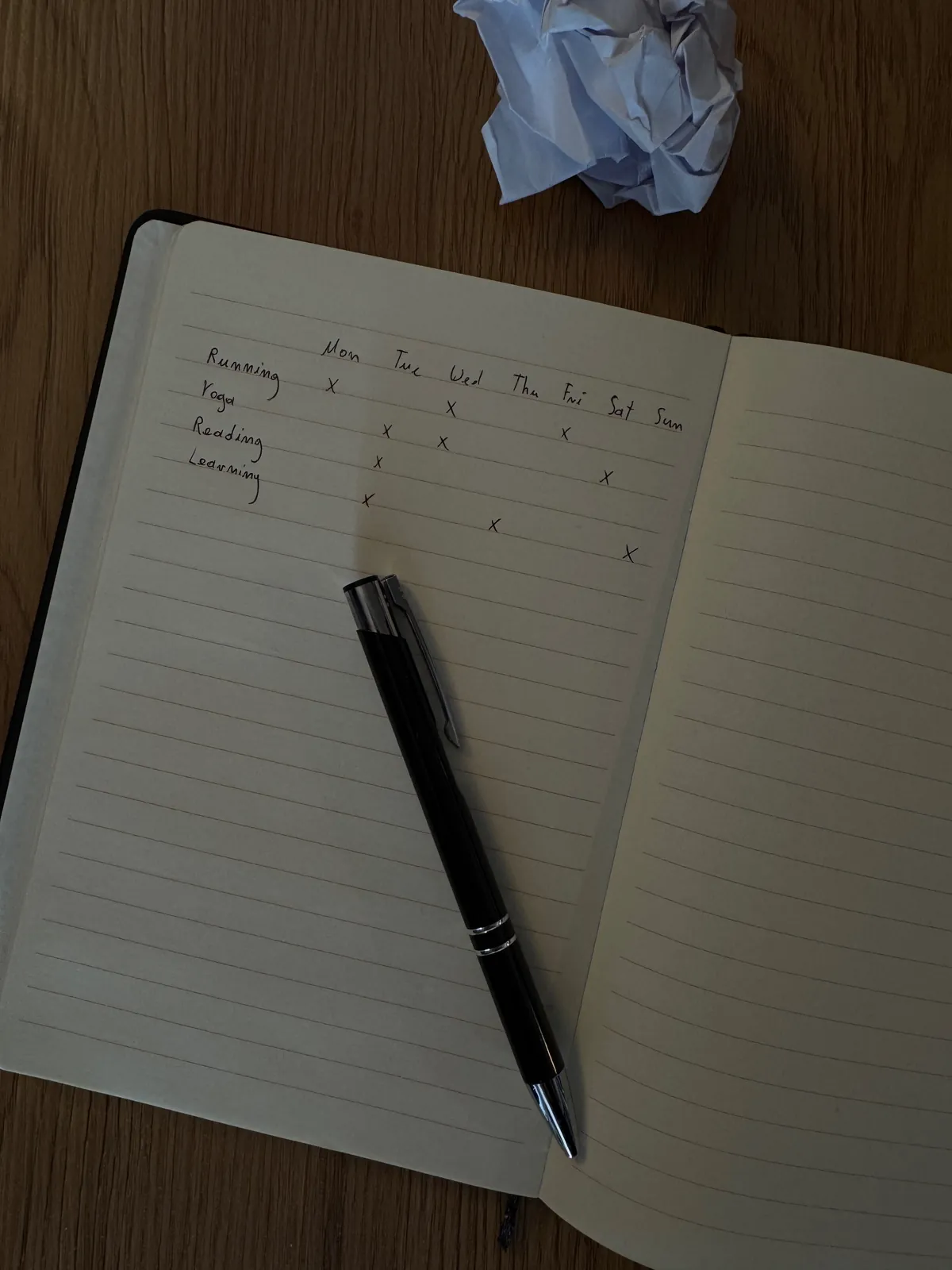
If you have ever quit a habit, you probably know these two weeks.
- new notebook. this time it's different
Day 1
Four habits. A neat grid. You even bought a pen for it.
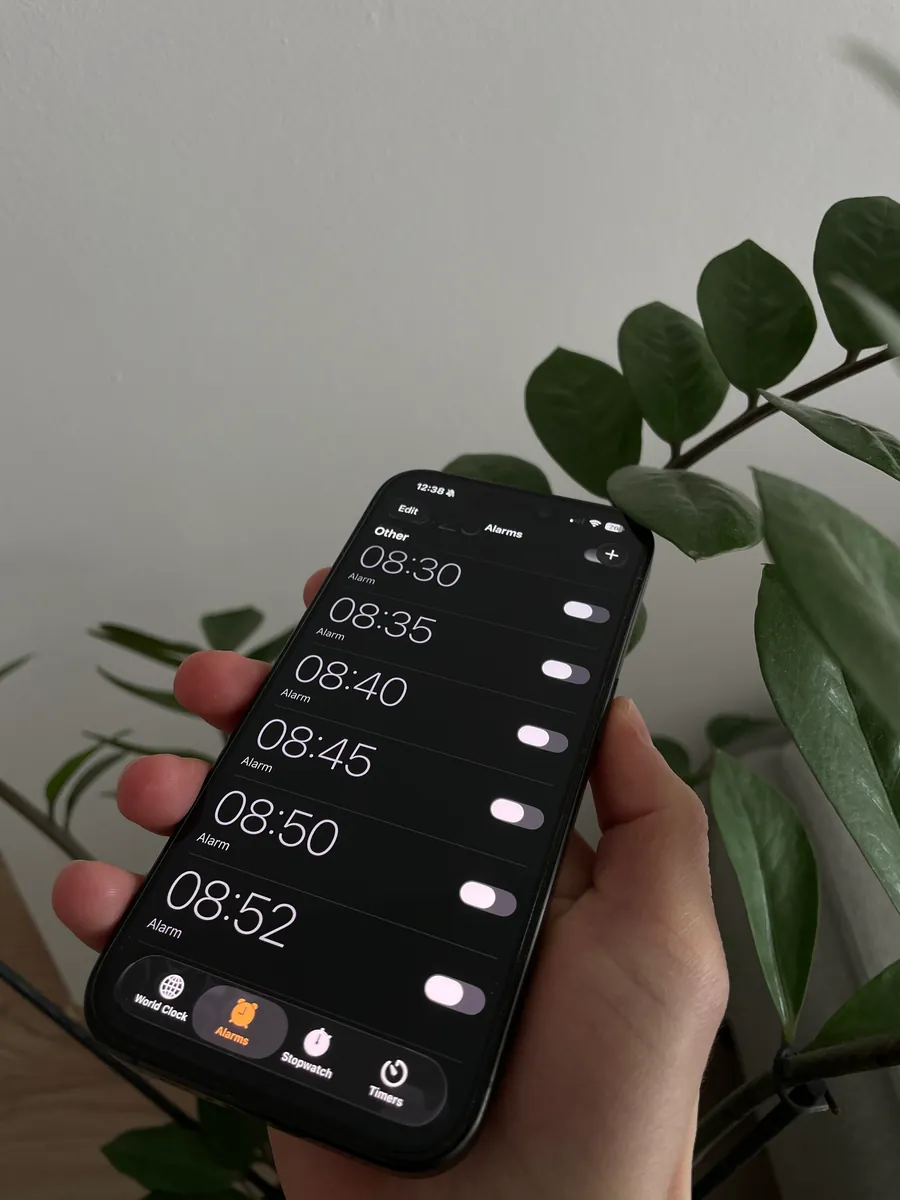
Day 6
Six alarms set for the morning run. You snoozed all six.
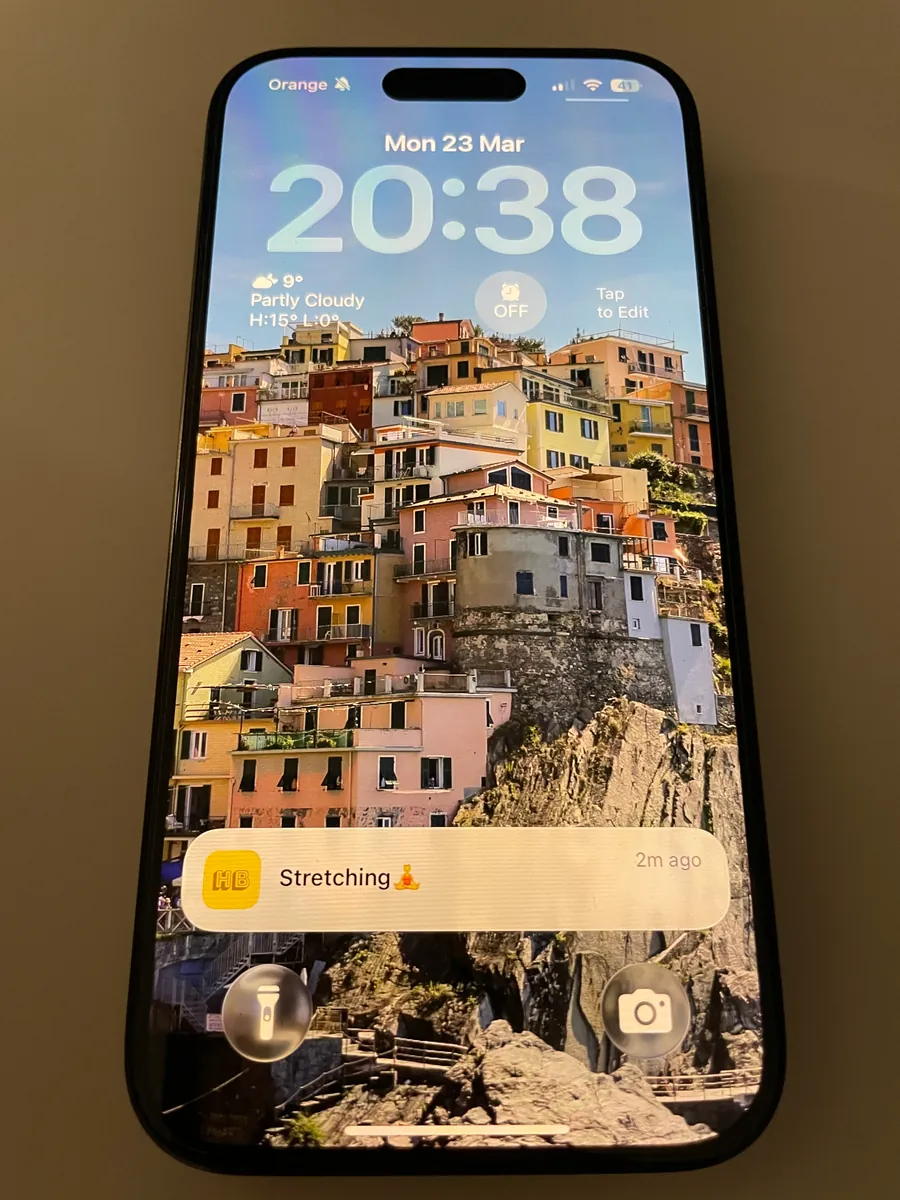
Day 9
The stretching reminder pops up. You swipe it away. Nothing happens.
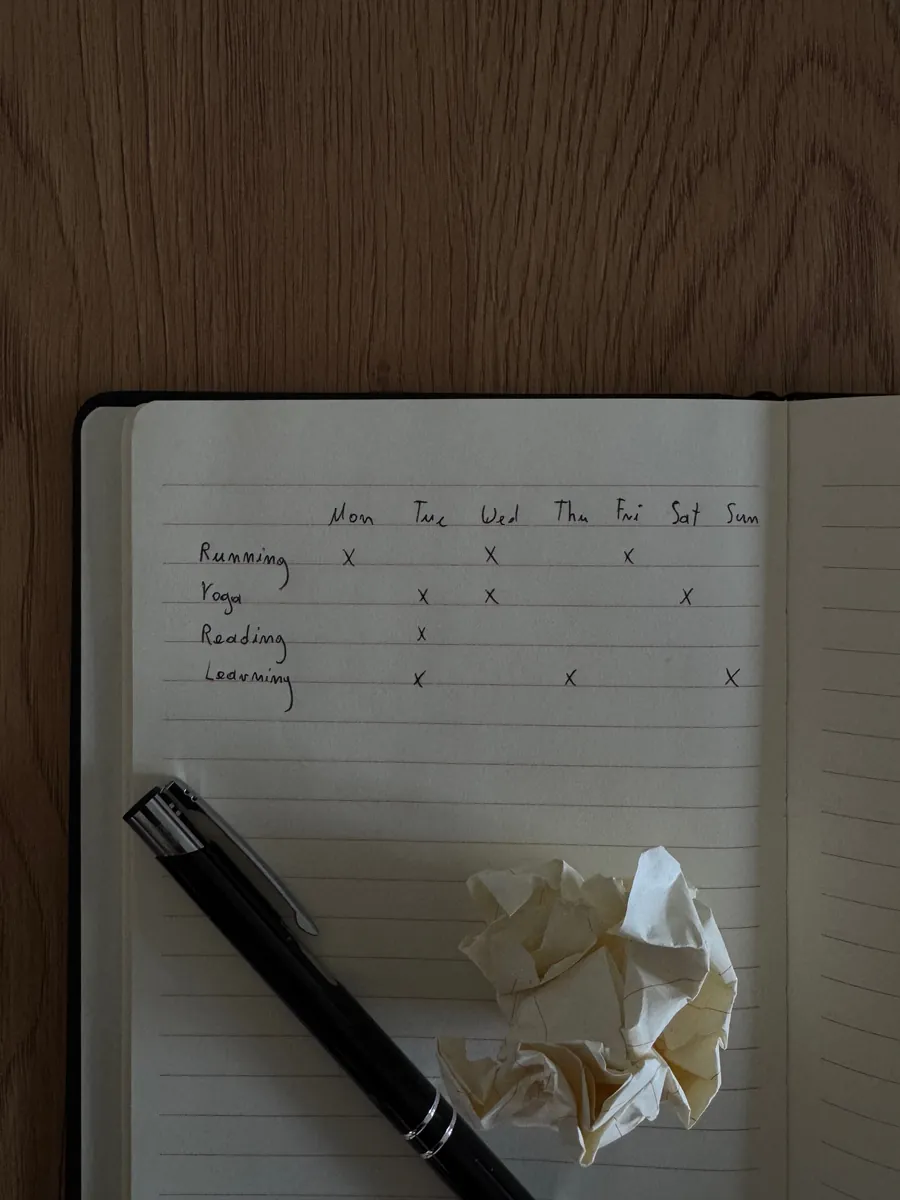
Day 14
The grid has more gaps than crosses. The page comes out.

Day 14, 9 pm
The controller rewards you in three seconds. The habit rewards you in three months.
None of those days involved a lack of willpower. Each one was a fair trade from your brain's point of view: a cost now, for a benefit nobody could see yet.
Why you quit around day 14
A new habit costs effort every single day. What it gives back comes in a lump, much later: the fitter body, the language you can actually speak, the back that stops hurting. In the first days novelty covers that gap. Starting feels good on its own, the notebook is new, and you tell people about it.
By the second week the novelty is spent and the results are still weeks away. For a while every day costs something and gives you nothing you can see. This is the delayed reward trap, and it is where my own habits used to die.
Behavioural economists have a name for the pull toward now: present bias. We weigh what happens now far more heavily than what happens later, and in 1999 the economists Ted O'Donoghue and Matthew Rabin built a model of how that makes people keep postponing tasks whose cost comes first. Research on goals fits the same picture. In five studies covering New Year's resolutions, studying and exercise, Kaitlin Woolley and Ayelet Fishbach found that immediate rewards, such as enjoying the activity, predicted who kept going. The delayed benefits people said they cared about did not.
How long does it take to form a habit?
It takes longer than you were told. The famous 21 days traces back to Psycho-Cybernetics, a 1960 book by the plastic surgeon Maxwell Maltz. He wrote that people need at least about three weeks to get used to a change such as a new face, which is a different claim, and it was never a study of habits. When researchers at University College London followed 96 volunteers building one daily habit for twelve weeks, the 39 people whose progress fit the researchers' model took a median of 66 days to reach a stable level of automaticity. Individual estimates ranged from 18 to 254 days, so 66 is a midpoint, not a deadline.
Measured against that median, stopping on day 14 means stopping about a fifth of the way there.
The same study found that missing a single day did not materially change how the habit formed. What the researchers did link to success was consistency over the whole period, not a perfect record.
The rule that fixes it: Make it satisfying
The idea is older than any habit book. Around 1900 the psychologist Edward Thorndike watched cats learn to escape puzzle boxes and described what became known as the law of effect: an action followed by a satisfying result tends to be repeated, and one followed by an unpleasant result tends to fade. James Clear's Atomic Habits brought it to habits as "make it satisfying", the fourth of his four laws.
The catch is the timing. A result three months away is not something that follows the action, so it does very little to make you repeat it. Clear's rule is about the first half below. The second half is my own extension of it, and the idea Habit Bank is built on:
- Make doing it satisfying now. Something you enjoy, seconds after the habit, not someday.
- Make skipping it cost something now. A small price you feel today, instead of a vague regret in March.
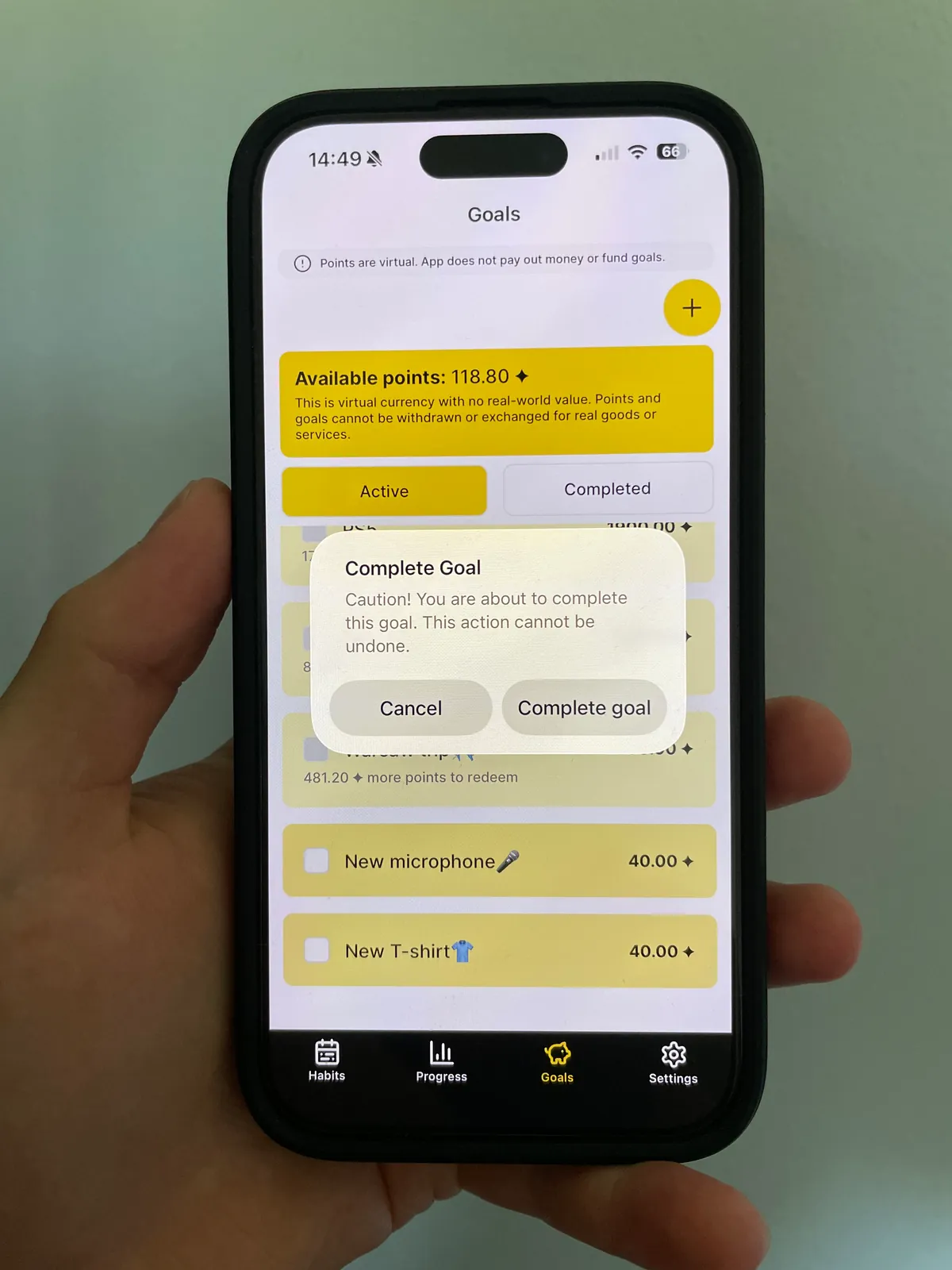
A typical habit tracker covers part of the first one. You get a checkmark and a streak. When you skip, the streak goes back to zero and nothing else happens, which is why skipping is so easy.
A streak is a score. A penalty is a consequence.
How to make a habit stick in 5 steps
- Name the reward you get today. Not the one in three months. If you can't name one, the habit doesn't have one yet, so add one.
- Put the reward right after the habit. Seconds, not hours: a checkmark, points on a balance, the coffee you only have after the run, the podcast you only play while stretching.
- Give skipping a small cost today. A friend who is waiting for you at 7, a written agreement with someone, points that come off when you don't show up. Keep it small enough that you accept it without arguing.
- Don't let the reward undo the habit. A cake after every workout teaches you to work out for cake, and it cancels part of the workout.
- Get back to it the next day. In the UCL study one missed day changed almost nothing, while overall consistency did. A miss only costs you the habit if you treat it as a reason to start over next week.
Examples of rewards that arrive today
| Habit | The reward that comes too late | A reward today | A cost of skipping today |
|---|---|---|---|
| Running | Being fitter in three months | The playlist you only allow yourself on runs | A friend waiting at the corner at 7 |
| Reading | Knowing more by next year | Tea and one page of a book you actually like | Points off your balance |
| Studying | A better grade in June | One episode after 25 focused minutes | Telling your study group you skipped |
| Stretching | No back pain someday | Five minutes with your favourite podcast | Points off your balance |
| Flossing | Healthier gums at the next check-up | The clean feeling, plus a checkmark | A streak and points that both drop |
When it doesn't work
- When the reward undoes the habit. If your reward for a run is a pastry, you end up training for pastries. Pick rewards that don't fight the goal.
- When the cost is so harsh you quit the system. A penalty bigger than you can stomach makes you delete the app. Start with a penalty lower than the reward for doing the habit, and raise it only once skipping is rare.
- When you are sick or travelling. Penalising a week of flu teaches you nothing. Habit Bank has a Holiday Mode (a Pro feature) that pauses penalties without resetting your streaks, and you have to switch it on before you're away.
- When it isn't really about rewards. If you suspect ADHD, depression or burnout is behind it, no reward schedule will fix it, and that is not a willpower problem either. Talk to a professional.
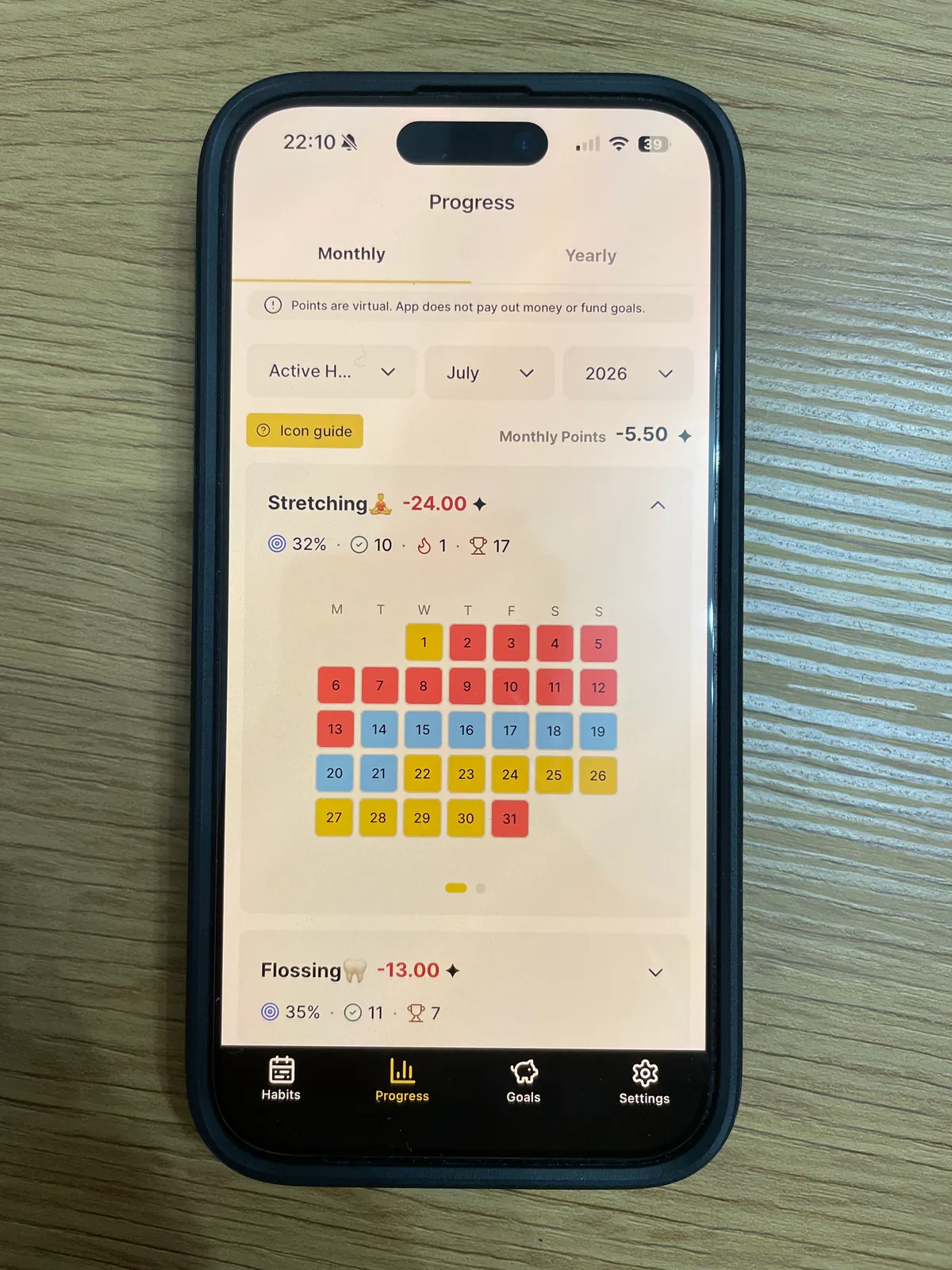
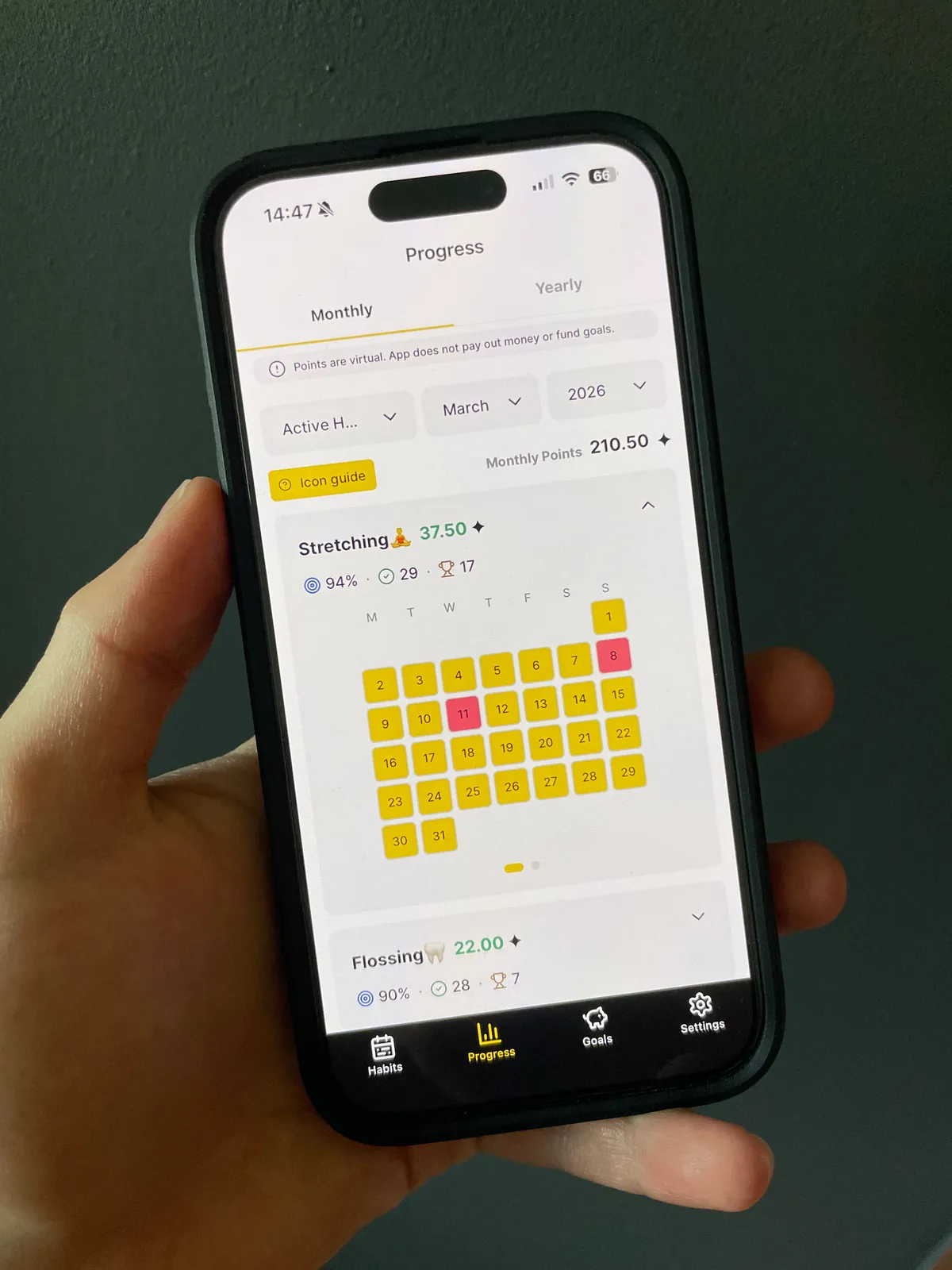
- When you expect the tracker to do the work. A tracker only shows you what happened. Here is my own July next to my March, in the same app with the same habits.
How I do it myself
I tracked habits on paper first. I ticked boxes, felt organised and changed nothing, because an empty box costs exactly zero. Nobody notices it, including you.
I didn't need more willpower. I needed a witness.
So I built Habit Bank around a second number. Every habit has a Habit value, the points you get for doing it, and a Penalty value, the points you lose when you skip a scheduled day. I picked my own numbers: my Workout habit is +2 pts if I do it and -4 pts if I skip it, Stretching is +1.50 pts and -3 pts. Skipping costs me more than doing earns, on purpose.
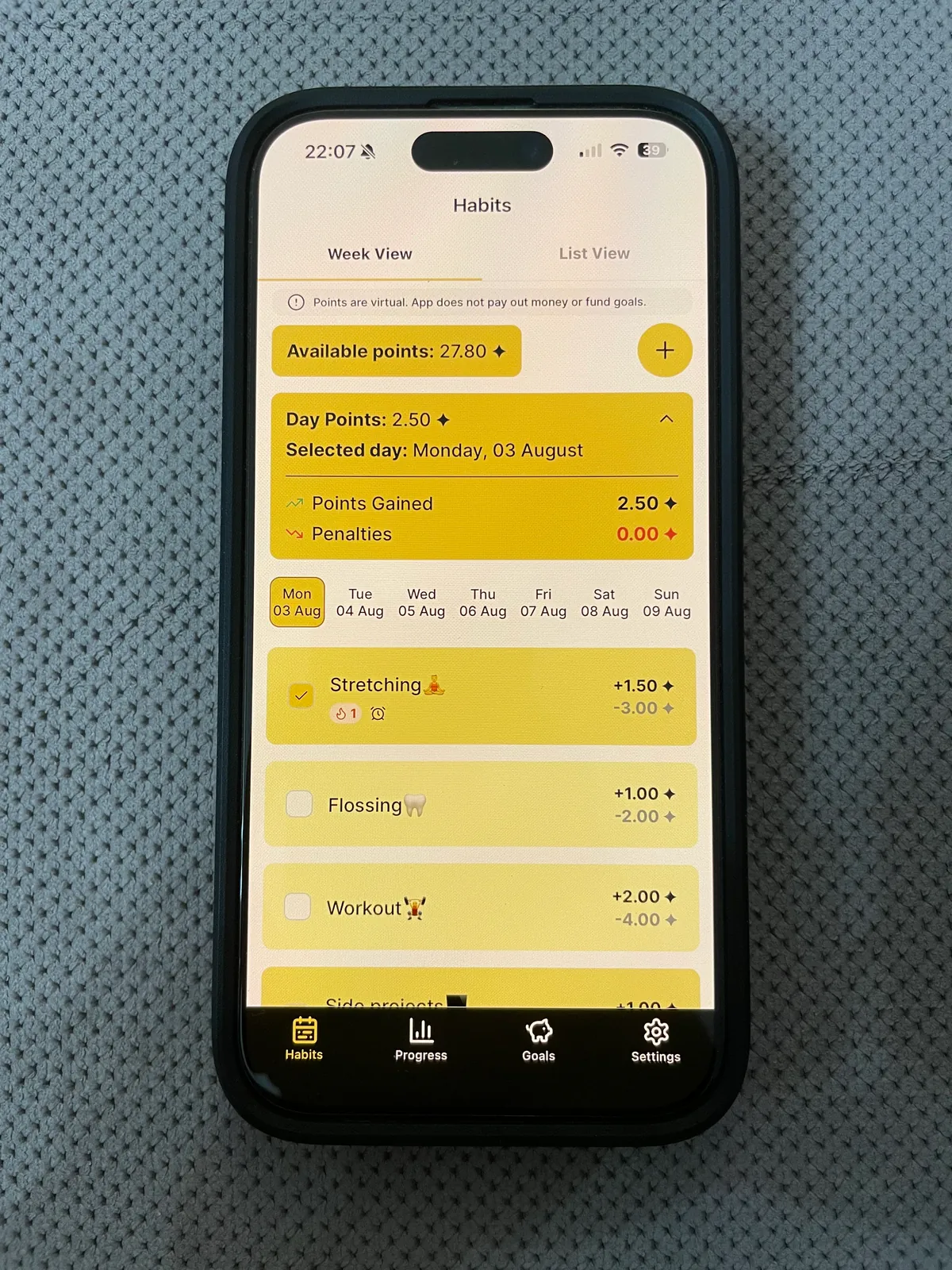
It doesn't make me perfect. My longest Stretching streak is 17 days, and then it died, right on the curve above. The difference is what the skipped days did. In a normal tracker the streak resets and that's it. In mine, every skipped day also took points off, and I felt it the same evening, not three months later.
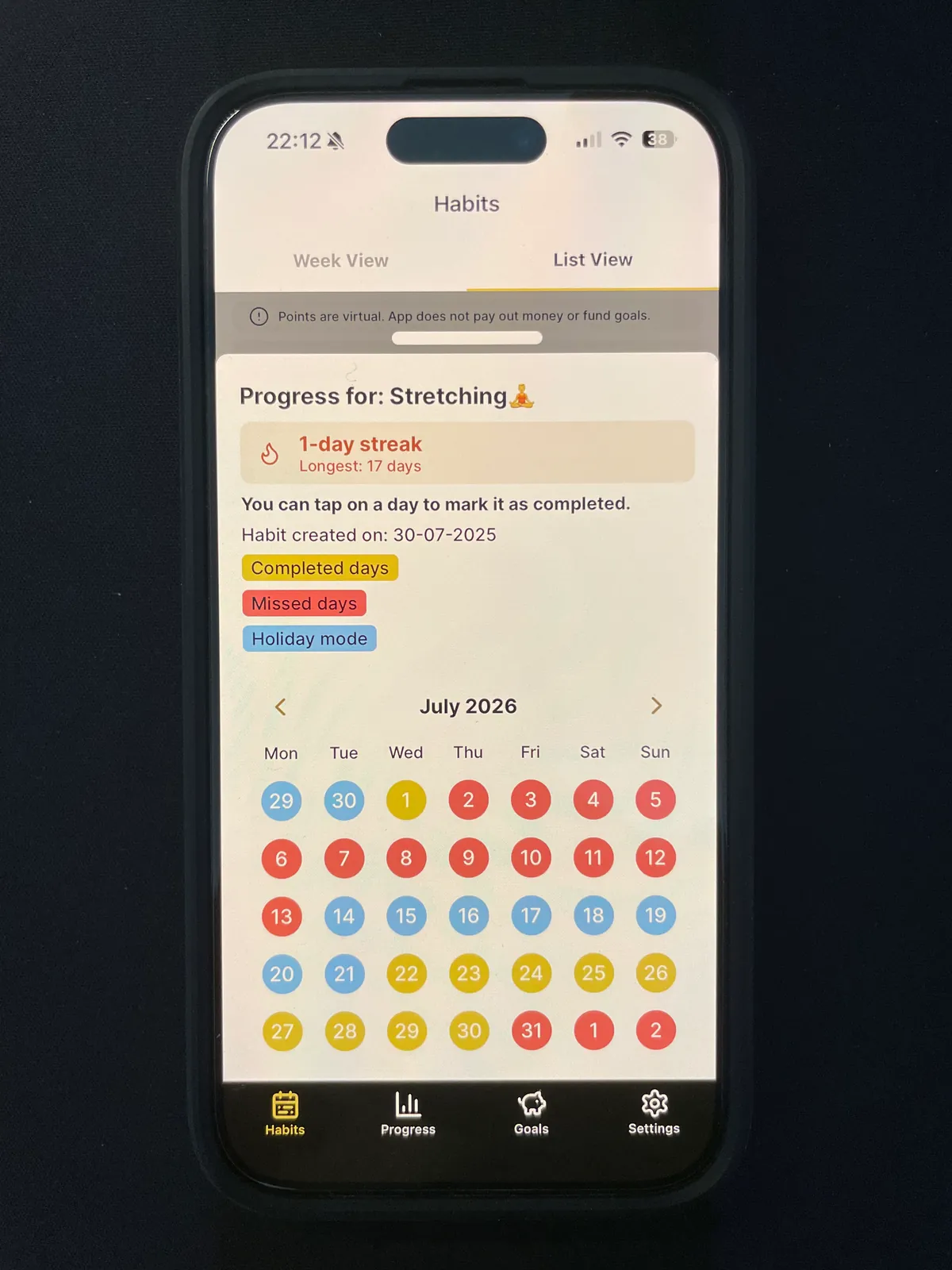
Try it with my Workout numbers. Tap a day to skip it.
My Workout habit: +2 pts if I do it, -4 pts if I skip it.
+28 pts
Tap a day to skip it. Tap again to undo.
Fourteen days done. In a normal tracker, skipping one would cost you nothing but a checkmark.
That second number is the whole reason I built Habit Bank. You always set it yourself. The first habit you create starts at +3 pts with a -1 pts penalty, and every habit after that starts with no penalty at all until you add one.
Frequently asked questions
›Why is it so hard to stick to a new habit?
Because the effort comes every day and the benefit comes months later. Your brain gives far more weight to what happens now, so once the novelty wears off, around the second week, the habit feels like pure cost. A small reward right after it, or a small cost for skipping it, closes that gap.
›What is the 21-day habit rule?
It is the popular claim that a habit forms in 21 days. It comes from a 1960 self-help book, not from a study. When researchers at University College London followed people building one daily habit, the median time to automaticity was 66 days, and their estimates ranged from 18 to 254 days.
›Is it bad to miss one day of a new habit?
No. In the same UCL study, missing a single day did not materially change how the habit formed. What the researchers did link to success was overall consistency, so treat one miss as noise and get back to the habit the next day instead of starting over next Monday.
›How do you make a habit stick?
Make it rewarding today instead of someday. Put something you enjoy right after the habit, track it so you can see progress every day, and give skipping a small cost you will actually feel, like a friend waiting for you or points coming off a balance. Keep the first version small enough to repeat on a bad day.
›Does punishing yourself for skipping a habit work?
It can help when the cost is small, immediate and something you chose yourself. A punishment that feels unfair is easy to abandon along with the habit. Start with a penalty lower than the reward for doing the habit, pause it when you are sick or travelling, and raise it only once skipping has become rare.
Give a skipped day a price
Habit Bank gives every habit two numbers, points for doing it and a penalty for skipping it, so today always counts. Free on iOS.
More habit techniques
Paweł, creator of Habit Bank
Paweł Konieczny is a software developer from Poland and the creator of Habit Bank, the habit tracker that takes points away when you skip.
Sources
- Lally, P., van Jaarsveld, C., Potts, H., Wardle, J. (2010). How are habits formed: Modelling habit formation in the real world. European Journal of Social Psychology, 40(6), 998–1009.
- Woolley, K., Fishbach, A. (2017). Immediate rewards predict adherence to long-term goals. Personality and Social Psychology Bulletin, 43(2), 151–162.
- O'Donoghue, T., Rabin, M. (1999). Doing it now or later. American Economic Review, 89(1), 103–124.
- Thorndike, E. L. (1898). Animal intelligence: An experimental study of the associative processes in animals. Psychological Review Monograph Supplements.
- UCL Research Department of Behavioural Science and Health (2012). Busting the 21 days habit formation myth. Health Chatter blog.
- Clear, J. (2018). Atomic Habits. Avery.