
Nobody checks whether you did it? How to hold yourself accountable for a habit
Paweł, creator of Habit Bank · 12 min read · Updated November 5, 2026
To hold yourself accountable, make the goal something you can check with a number, let someone else see the result, and decide in advance what a miss costs. A promise to yourself fails because it is easy to renegotiate. Research backs the first two parts best, and the third is promising but mixed.
Who checks on your habit right now?

Here is how a goal with no one checking it slips away, without anyone deciding to drop it.
- tell nobody
Day 1
You decide to write every evening. You tell nobody, because it is your own project, and that feels like the grown-up way to do it.
- counts double
Day 4
You write on Monday and Tuesday. On Wednesday you are tired, and you decide Thursday will count double. Nobody knows the difference, and neither does the notebook.

Day 9
The desk is set up and the headphones are on. Then there is one thing to look up first, and the evening goes there.
- three, maybe four
Day 14
Count the fortnight and you cannot say how many evenings you wrote. Three, maybe four. Without a number, "pretty good" and "not really" are both true.
- nothing ever checked it
Day 21
The goal is still yours and has never been broken, because nothing ever checked it. It has just stopped appearing anywhere.
Why a promise to yourself is easy to bend
Accountability needs someone or something that notices a miss and does something about it. When you are both the person who promises and the person who checks, every check can be argued down: today was unusual, tomorrow will be better, three out of four is basically four.
There is some evidence for the optimism part. Daniel Acland and Matthew Levy ran a gym-attendance experiment and asked participants to predict how often they would go once the study's incentives were over. They guessed far higher than what they did. My reading, not theirs: a plan made on a good day is judged by the version of you who feels good, and that version does not turn up on Wednesday evening.
What helps: checking, a consequence, other people
The research below covers three different things: watching your own progress, attaching a consequence to a miss, and letting someone else see the result.
Checking your own progress
A team led by Benjamin Harkin pooled 138 randomised studies with nearly 20,000 participants in total. The studies tested interventions that make people check their progress toward a goal more often. On average, those interventions improved goal attainment by about 0.4 of a standard deviation, a modest but real gain. Two features went with bigger gains: results that were shared with other people, and progress that was recorded in a physical form, such as writing it down.
The goals in those studies were varied, and the review is about interventions that prompt monitoring, not about any one method. But it gives two practical hints: write the result down, and let someone see it.
A consequence you set in advance
Economists call a choice that makes a later slip more costly a commitment device. The idea was formalised in the 1950s, including by the economist Robert Strotz, and the best-known illustration is older: Odysseus had himself tied to the mast so he could hear the Sirens without steering towards them. Gharad Bryan, Dean Karlan and Scott Nelson reviewed the field evidence and distinguish hard commitments, which carry a material cost, from soft ones, which work through how we feel about breaking our word.
Two field studies show both the promise and the catch.
- A company gym. Heather Royer, Mark Stehr and Justin Sydnor studied workers at a large company. They were given an incentive to use the gym that ran for a month, and once it ended, little of the change remained. At that point some workers could sign a commitment contract that they would fund themselves. There was demand for it, and in that group the change was still visible years later.
- A smoking-cessation trial. Scott Halpern and colleagues enrolled 2,538 people, employees of one company along with family members and friends, and assigned them to four programmes. Two asked for a refundable deposit that came back with a reward for those who quit, and two offered only a reward. When a deposit programme was the assignment, 13.7% accepted it. For a reward programme, 90.0% did. Overall, the reward programmes had more people who stayed off cigarettes through six months, 15.7% against 10.2%. Among the estimated 13.7% who would have accepted either kind, the deposit programmes did better, by 13.2 percentage points, with a wide margin of error (3.1 to 22.8).
Put together, a consequence seems to help the people who sign up for one, and most people won't. Those studies used real financial deposits, and I am not suggesting that. They also don't tell us how large a consequence needs to be. A cost you can actually live with, delivered every time, is the version worth trying.
Other people who see the result
Besides the finding above that reported or public results worked better, one trial put the social side into a game. Mitesh Patel and colleagues gave 200 adults from 94 families step goals and daily feedback. For the families in one group, they also ran a game with points and levels that was meant to make relatives more answerable to one another. Over the 12 weeks of the game, that group reached the step goal on 53% of participant-days, against 32% in the comparison group. After the game ended, the gap shrank, 44% against 33%, but it did not disappear.
That trial combined points, levels and family support, so it can't say which part did the work. The participants were adults from one long-running heart-study cohort. It does suggest that a points game with people around you can beat tracking alone for a while, and that the effect fades once the game stops.
How to hold yourself accountable in 5 steps
The steps below are my own plan, built on the studies above. Each one says how far the evidence goes.
- Make the goal something a stranger could check. "Get fit" can't be checked. "Run three times this week" can. Choose a number for one week at a time. This is my step: the monitoring studies need something to monitor, and a vague goal gives you nothing to count.
- Record each result where you can see it. A calendar on the wall, a notebook or a spreadsheet will do. Physical recording is one of the things that went with larger effects in the Harkin review, though that review does not compare a wall calendar with a spreadsheet.
- Let someone else see the result. Reported and public results did better in the review, and there is more than one way to do it: hang the calendar where the people you live with walk past it, post a weekly "done" or "missed" in a group chat, or leave the sheet on the table on Friday. Pick the version you won't dodge. Choosing a way that is read, not discussed, is my addition, because a lecture is a good reason to hide a miss.
- Decide the consequence before the week starts. Write it as an if-then line: "If I miss a run, I do the washing-up for the flat on Sunday." Keep it small enough that you will really do it. Then do it every time, because a consequence you skip once teaches you it is optional. That last point is my reasoning, not a finding. The commitment-device research is why I include a consequence at all.
- Review once a week and change the plan, not the rule. If you missed the target twice, ask whether the target was too big. Shrinking it is usually better than dropping the consequence. My post on starting tiny is about sizing it. The weekly review is my own step.
Examples: a vague promise next to an accountable one
| Goal | The vague promise | Something you can check | Who sees it | If I miss |
|---|---|---|---|---|
| Running | "I'll run more" | Three runs of 20 minutes this week | A weekly "done" or "missed" in a group chat | I do the washing-up for the flat |
| Writing | "I'll write every day" | Five evenings of 30 minutes | A note on the fridge door | The next morning, I write before I look at my phone |
| Studying | "I'll revise properly" | Three sessions of 25 minutes by Friday | The tick sheet left on the kitchen table on Friday | I give up one episode of a show that evening |
| Reading | "I'll read more" | 20 pages a day, five days | A tally on the book's last page | The page count carries over to the weekend |
| Language | "I'll practise Spanish" | Four lessons this week | A voice note to a sibling on Sunday | I do the lesson in the morning before coffee |
| Stretching | "I'll be more flexible" | Ten minutes, four mornings | A mark on the bathroom mirror | An extra five minutes the next day |
| Lights out | "I'll sleep earlier" | Phone off by 23:00 on five nights | A friend asks on Sunday | Phone charges in another room next night |
| Cooking | "I'll eat at home" | Four home-cooked dinners | A photo to my sister | The next takeaway has to wait a week |
When it doesn't work
- When you won't sign up for it. In the smoking trial, only about one in seven accepted a deposit programme, and the authors of the gym-attendance study suggest that few people choose such tools partly because they misjudge their own future behaviour. A plan that needs the strict version only works for people who start it.
- When the consequence is skipped. A penalty you waive once teaches that it is optional. That is my observation, not a finding.
- When the person watching becomes a judge. If you start hiding misses to avoid a lecture, the check has stopped working. I found no study on this, so it is my judgment.
- When it is about food, weight or your body. Penalties and guilt around eating can do harm. If you have a history of disordered eating, or you notice that a penalty makes you anxious, drop it and talk to a doctor or a therapist.
- When the effect fades. In the family game, the benefit shrank once it ended, and in the workplace study the short incentive on its own left little behind once it ended. Expect to adjust the plan, not set it once.
- When the goal is not yours. If someone else set it, accountability turns into obedience. Ask whether you want it before you build a system around it.
- When the evidence is thin. I found no study of holding yourself accountable as such. The studies are about gym use, smoking and steps, with workers, volunteers and families, and the steps above borrow from them. Treat this as a reasonable plan to test, not a proven recipe.
- When it isn't a habit problem. If everything has felt flat and hard to start for weeks, not only one habit, it may be depression, burnout or something else that accountability cannot fix. Talk to a doctor or a therapist.
How I do it myself
In Habit Bank every habit carries two numbers, a Habit value for doing it and a Penalty value for missing it. If I haven't checked a habit off by midnight, the penalty is counted, so I never have to be the one who enforces it. The points are virtual: the app says so on the screen and does not pay out or fund anything. I have not seen a controlled test that isolates virtual penalties, so that part is my experience, not evidence.
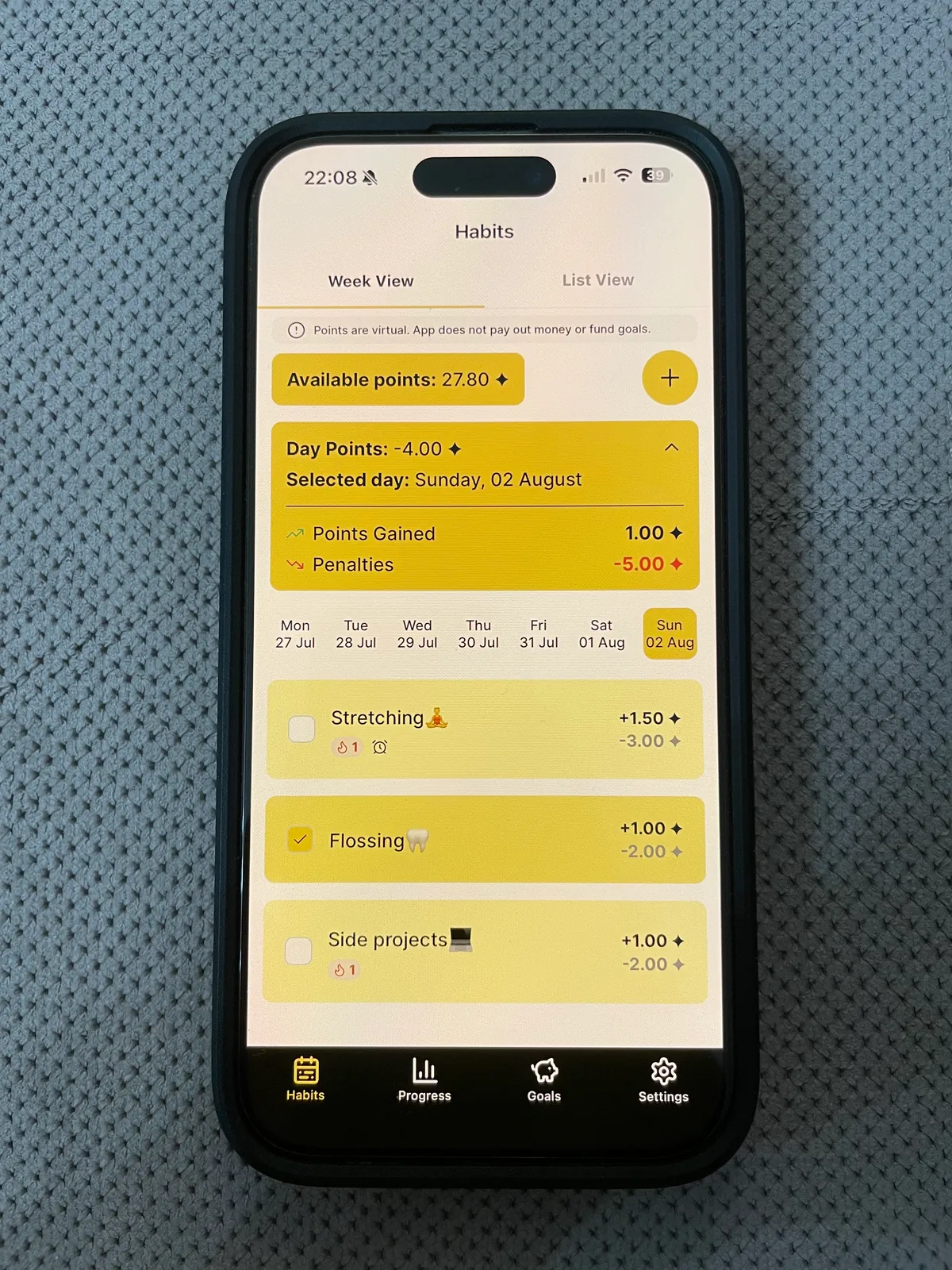
I respond to losing things. I've stopped pretending otherwise.
Frequently asked questions
›How do you hold yourself accountable when no one is watching?
Make the goal something you can check with a number, write the result down where you can see it, and decide before the week starts what a miss will cost you. If you can, make the result visible to someone else. Each part removes a way of quietly renegotiating with yourself.
›Does telling someone your goal help?
The best evidence is about reporting progress, not announcing a goal. In a meta-analysis of 138 randomised studies, monitoring progress helped more when the results were reported or made public. That finding does not cover announcing a goal and then saying nothing more, so send results, not just intentions.
›What is a commitment device?
It is a choice you make now that makes a later slip more costly or harder to do. Researchers separate hard ones, which carry a material cost, from soft ones, which rely on how you feel about breaking your word, such as telling a friend. The story of Odysseus tied to the mast is the usual illustration.
›Do penalties work for habits?
Sometimes. In a large smoking-cessation trial, people who took a deposit programme did better than people who took a reward programme, but only about one in seven offered a deposit accepted it. I found no controlled test that isolates virtual penalties, so treat any penalty as an experiment you can drop.
›How do you hold yourself accountable for studying?
Replace "study more" with a block you can count, such as three 25-minute sessions by Friday. Tick each one off on paper, leave the count where a housemate or friend can see it by Friday, and decide in advance what a missed session costs, like a chore you dislike. Shrink the block after two missed weeks.
Make a miss count
In Habit Bank every habit has a Penalty value that comes off your points at the end of the day, and the points are virtual. Free on iOS.
More habit techniques

Make it obvious
How to be consistent without motivation: put the habit where you'll see it
Motivation is high when you make the plan and gone by evening. Why consistency comes from cues, not willpower, and how to put a habit where you can't miss it.
· 11 min read

Restart plan
Stopped a habit and want it back? How to restart it without starting from zero
A break does not erase a habit. Why habits stop, what research says about restarting, and a five-step plan to get back into one without the guilt.
· 11 min read
Paweł, creator of Habit Bank
Paweł Konieczny is a software developer from Poland and the creator of Habit Bank, the habit tracker that takes points away when you skip.
Sources
- Harkin, B., Webb, T. L., Chang, B. P. I., Prestwich, A., Conner, M., Kellar, I., Benn, Y., Sheeran, P. (2016). Does monitoring goal progress promote goal attainment? A meta-analysis of the experimental evidence. Psychological Bulletin, 142(2), 198–229.
- Bryan, G., Karlan, D., Nelson, S. (2010). Commitment devices. Annual Review of Economics, 2, 671–698.
- Strotz, R. H. (1955). Myopia and inconsistency in dynamic utility maximization. The Review of Economic Studies, 23(3), 165–180.
- Royer, H., Stehr, M., Sydnor, J. (2015). Incentives, commitments, and habit formation in exercise: Evidence from a field experiment with workers at a Fortune-500 company. American Economic Journal: Applied Economics, 7(3), 51–84.
- Acland, D., Levy, M. R. (2015). Naiveté, projection bias, and habit formation in gym attendance. Management Science, 61(1), 146–160.
- Halpern, S. D., French, B., Small, D. S., Saulsgiver, K., Harhay, M. O., Audrain-McGovern, J., Loewenstein, G., Brennan, T. A., Asch, D. A., Volpp, K. G. (2015). Randomized trial of four financial-incentive programs for smoking cessation. New England Journal of Medicine, 372(22), 2108–2117.
- Patel, M. S., Benjamin, E. J., Volpp, K. G., Fox, C. S., Small, D. S., Massaro, J. M., Lee, J. J., Hilbert, V., Valentino, M., Taylor, D. H., Manders, E. S., Mutalik, K., Zhu, J., Wang, W., Murabito, J. M. (2017). Effect of a game-based intervention designed to enhance social incentives to increase physical activity among families: The BE FIT randomized clinical trial. JAMA Internal Medicine, 177(11), 1586–1593.