
Want to change your life but don't know where to start? Pick one habit and shrink it
Paweł, creator of Habit Bank · 12 min read · Updated October 29, 2026
Start with one habit, and shrink it until you could do it on your worst day. Changing your life is really a pile of daily habits, and a pile asks for effort in every one of them at the same time. A tiny first habit asks for almost none, so it is still standing on the days the big plan isn't.
What did your last big reset look like?

Here is a Sunday night that ends on Thursday.
- new list: 7 things
Sunday, 9:40 pm
A clean page, a new start. You write the list: up at 5:30, the gym four times a week, no sugar, a journal, thirty pages of a book, a cold shower, meals cooked for the week.
- done: 6 / 7
Monday
The alarm goes at 5:30 and you get up. By evening you have done six of the seven things, and you feel like a different person.
- done: 5 / 7
Tuesday
Five of seven. The cold shower was the first to go, and nobody noticed but you.
Wednesday, 7 pm
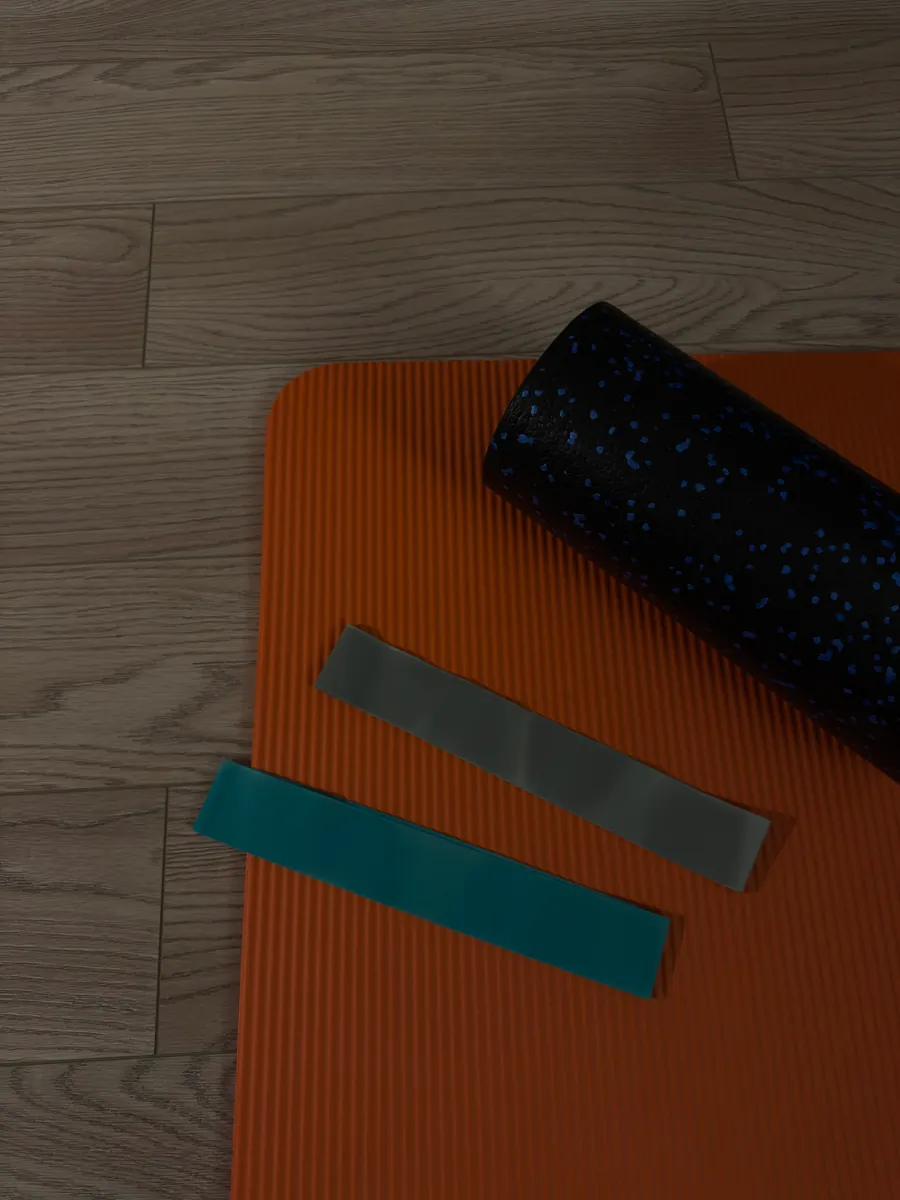
You are tired. The mat is where you left it on Monday, with the bands next to it, untouched.
- done: 0 / 7
Thursday
You look at the list. Seven lines, and you can't tell which one to do first, so you do none of them.
Nothing dramatic happened between Sunday and Thursday. The plan had been sized by Sunday night's energy and carried out on ordinary days.
Why a plan for your whole life is hard to keep
There are two things going on when you decide to change everything.
The first is the timing. Hengchen Dai, Katherine Milkman and Jason Riis called it the fresh start effect. They looked at Google searches, at the gym visits of 11,912 students at one US university, and at goals posted on a goal-setting website. In each, people moved toward self-improvement right after a landmark: a new week, month, year or semester, a birthday, a holiday. At that university gym, a student's chance of showing up on a given day was about a third higher at the start of a week and close to half higher at the start of a semester, compared with a normal day. The authors' explanation is that a landmark works like turning a page: earlier failures start to feel like they belong to someone else, and people step back to look at the whole picture. That is exactly the mood that produces a seven-line list.
The second is the size of the plan. The psychologists Janet Polivy and C. Peter Herman reviewed why people keep making ambitious plans to change themselves even after earlier plans failed. They call the cycle the false hope syndrome and argue that it rests on expectations that are too rosy, among other things about how fast the change will come and how easy it will be.
My reading, not theirs: a Sunday-night plan is built by the most hopeful version of you, and the habits are done by the version who has had a long Wednesday. My post on why habits fade in the second week is about what that second version is up against.
None of this means resolutions are a waste. John Norcross and colleagues followed 159 people who made a New Year's resolution and 123 people with similar goals who didn't make one. After six months, 46% of the resolvers said they had kept it up continuously, against 4% of the others. That was self-reported in phone interviews, and people chose for themselves whether to resolve, but the gap is big enough to say that making a fresh start didn't hurt. The study didn't compare big plans with small ones, so it can't tell you how big your first step should be. The rest of this post is about that.
Where tiny habits come from
Making a habit tiny has a few sources, plus a namesake rule that does something else.
B. J. Fogg of Stanford's Behavior Design Lab laid out a behaviour model in 2009. In it, a behaviour happens only when motivation, ability and a prompt are all present at the same moment. Motivation and ability trade off, so a behaviour that is very easy needs little motivation. Fogg's Tiny Habits method turns that into practice by shrinking the new behaviour on purpose. James Clear's Atomic Habits (2018) later popularised a related instinct under the name "the two-minute rule", which asks you to scale a new habit down until it takes about two minutes.
What the evidence says
Fogg's model is a framework, not an experiment, and I couldn't find a controlled trial of the Tiny Habits method itself. The closest evidence I found is about small changes in general.
Lisa Lutes and colleagues tested a small-changes approach against ordinary advice. They split 59 adults who were overweight or obese and rarely active into three groups for four months. In the first, people picked small changes to how they ate and moved, and kept adding to them. The second got standard health education, and the third waited. Everyone in a programme did the same exercise training. At the end, the small-changes group had lost 4.4 kg on average, the education group 1.1 kg, and the waiting group had put on 0.1 kg. Three months later, the small-changes group was still 4.1 kg lighter than at the start.
That is one small trial, about weight, and nobody tested whether tiny beats big across the board. It is a hint that small steps can carry weight over months, not proof that they work for every goal.
How many habits should you build at once?
"One at a time" sounds like the obvious answer, and the evidence for it is thinner than you'd think. Hyman and colleagues tested the idea in a clinic with 289 adults aged 45 to 64. All had high blood pressure, and none was yet doing what doctors advise on three things: smoking, salt and walking. One group was counselled on all three at once. A second group was counselled on one new goal every six months. A third was only pointed to classes that already existed.
After 18 months, between 5% and 7% of each group had hit at least two of the three targets, even the group that only got the pointer. On single goals, the all-at-once group tended to do better: at six months, 29.6% of them had reached the salt target, against 16.5% of the one-at-a-time group. The authors' own conclusion was that going one at a time was not superior, and might be inferior.
Two things follow. Changing several behaviours for good is hard however you order them, and I found no study showing that going one at a time wins. So I won't give you a magic number. What the small-changes trial points to is size, not count: a change small enough to keep. My own suggestion for the first week is a single habit, because it is easier to see whether it is working. That's a judgment call, not a finding.
How to start changing your life in 5 steps
- Choose one area, not a list. Pick the area where a small win would make tomorrow lighter: sleep, food, movement, a morning that isn't a scramble. This is my suggestion, not a finding, but it keeps the first habit from feeling like a sacrifice.
- Shrink it until it takes almost no effort. Ask which version of the habit you would still do ill, tired or on a train. "Get fit" is not an action. Ten squats is. A tiny habit has a start and an end that you can see.
- Hang it on something that already happens. Pick a moment that is fixed anyway: the kettle boiling, brushing your teeth, closing the laptop. Do the tiny habit then. Fogg's method calls such a moment an anchor, and it does the job of a cue. My post on being consistent without motivation explains why that works better than a reminder.
- Count the tiny version as a full win. If you did the ten squats, you did the habit. Doing more that day is welcome, but it isn't what the habit asks. Otherwise a day with only ten squats feels like a failure, and a feeling like that is how people quit.
- Make it bigger only when it has become easy, and only a notch. After a few weeks, when the tiny version feels like nothing, raise it a little or put a second tiny habit next to it. That has the same shape as the small-changes trial, where changes built up over time. There is no right number of days. Let boredom tell you.
Examples: the big plan next to its tiny version
| Goal | The big plan | The tiny version | Hang it on |
|---|---|---|---|
| Get fitter | The gym five days a week | Ten squats | The kettle boiling |
| Sleep better | In bed by 10:30 every night | Put your phone on the charger across the room | Brushing your teeth |
| Eat better | Cook every meal from scratch | Chop one vegetable | Getting home |
| Learn a language | An hour of lessons a day | Say one sentence out loud | The walk to the bus |
| Write | Finish a chapter a week | Write one bad sentence | The first coffee |
| Tidy the flat | Declutter everything | Put five things back where they live | Before you sit down for the evening |
| Calm down | Twenty minutes of meditation | Three slow breaths | Before you open email |
| Study | Three hours of revision | Do one practice question | After dinner |
When it doesn't work
- When the tiny version becomes the ceiling. If you do ten squats for a year and never go beyond them, you have a habit, but maybe not the change you wanted. Step 5 is there for that.
- When the goal needs hours. Training for a marathon or preparing for an exam takes volume. A tiny habit gets you to the starting line. It doesn't do the hours for you.
- When nothing triggers it. A tiny habit still needs a moment to happen in. Without one, you will forget it as easily as the big plan.
- When it is the wrong habit. A perfectly tiny habit in a direction you don't care about will not change your life. If you keep skipping even ten squats, ask whether you want this at all.
- When the evidence is thin. I found no controlled trial of the Tiny Habits method itself. The small-changes trial is small and about weight. Treat this as a reasonable way to start, not a proven recipe.
- When what you need is a big change. A job that is wearing you down or a home that isn't safe won't be fixed by squats. This post is about habits, not about those decisions.
- When it isn't a habit problem. If everything feels flat and hard to start, not only one habit, and it has lasted for weeks, it may be depression, burnout or ADHD. Talk to a professional.
How I do it myself
In Habit Bank a habit is either done for the day or it isn't, with no half credit, so when I create one I decide what the smallest version is that I would still do on a bad evening, and that version is the habit. The Habit value and the Penalty value are mine to set, and a penalty only feels fair when the habit is small enough to do tired.
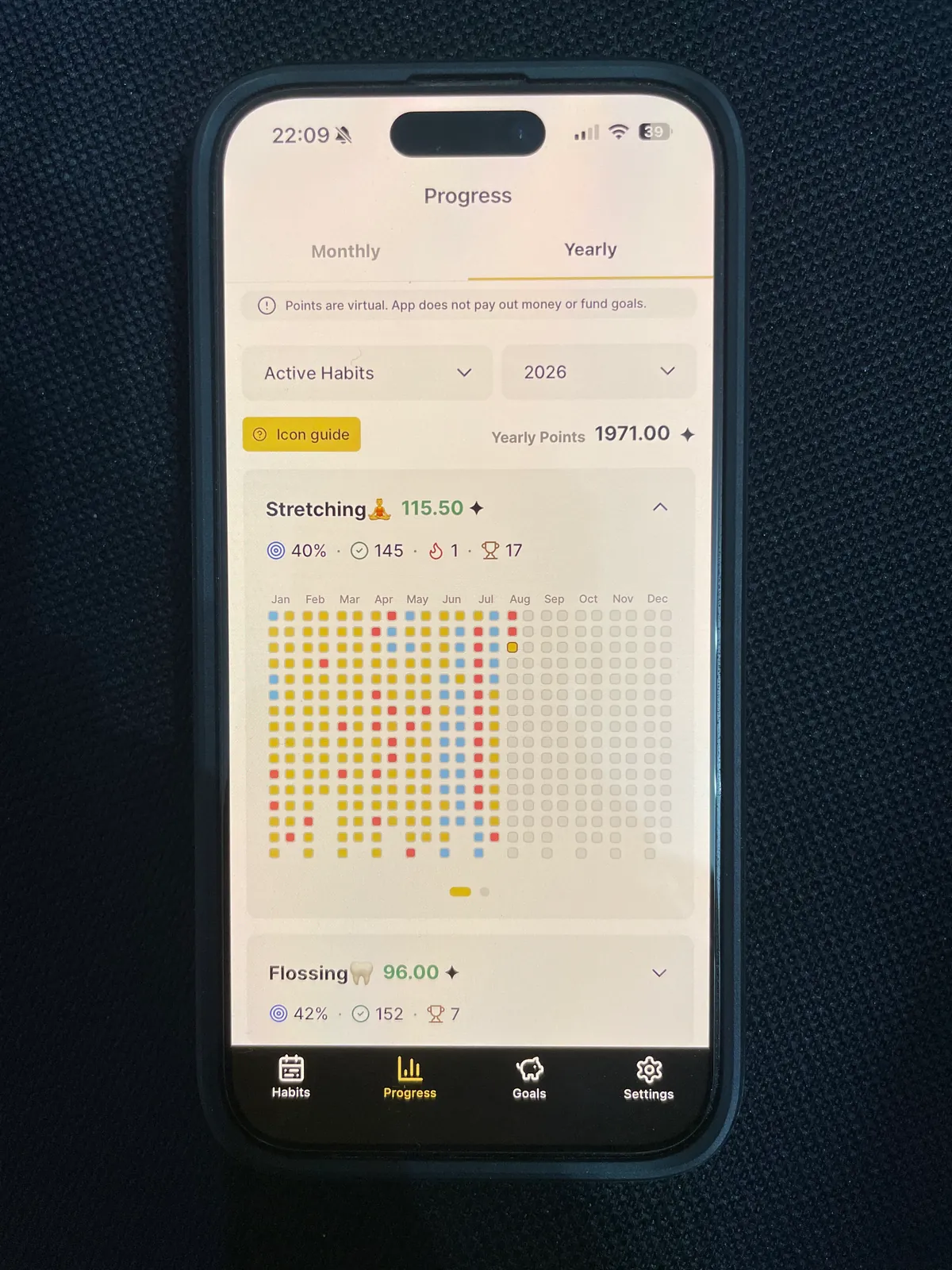
Every red square is a day I said "tomorrow".
Frequently asked questions
›Where do I start when I want to change my life?
Start with one habit, in the area where a small win would make tomorrow lighter, such as sleep, food or movement. Shrink it to a version you would still do on a bad day, and attach it to something you already do every day. Make it bigger only after it feels easy.
›What is the 2-minute rule?
It means scaling a new habit down until it takes about two minutes, so starting it is easy. James Clear popularised that version in Atomic Habits (2018). It is not David Allen's rule from Getting Things Done, where a task that takes under two minutes is done at once instead of being put on a list.
›How many habits should I start at once?
Research gives no magic number. In a 2007 clinic trial with 289 adults, adding goals one at a time did no better than working on three together, and few people in either group met at least two of the three goals after 18 months. If you are unsure, start with one tiny habit and add the next when the first feels easy.
›Do New Year's resolutions work?
In one study, people who made a resolution did far better than people with similar goals who didn't. John Norcross and colleagues followed 159 resolvers and 123 others. After six months, 46% of the resolvers said they had kept going continuously, against 4% of the others. People chose their group, and the study didn't test how big the resolutions were.
›What if I am too tired to start even a tiny habit?
Shrink it further, or tie it to a moment that already happens, like the kettle boiling. If everything feels flat for weeks, not only one habit, it may be depression, burnout or something else that a habit cannot fix. Talk to a doctor or a therapist.
Keep the tiny version done
In Habit Bank every habit has a Habit value for doing it and a Penalty value for skipping it, both set by you. A small habit you never skip adds up. Free on iOS.
More habit techniques
Make it obvious
How to be consistent without motivation: put the habit where you'll see it
Motivation is high when you make the plan and gone by evening. Why consistency comes from cues, not willpower, and how to put a habit where you can't miss it.
· 11 min read
Make it satisfying
Why can't I stick to habits? What goes wrong in the second week
Many habits die in the second week: the effort is due every day, the results come months later. Why that gap breaks you, and how to get a reward today.
· 11 min read
Paweł, creator of Habit Bank
Paweł Konieczny is a software developer from Poland and the creator of Habit Bank, the habit tracker that takes points away when you skip.
Sources
- Dai, H., Milkman, K. L., Riis, J. (2014). The fresh start effect: Temporal landmarks motivate aspirational behavior. Management Science, 60(10), 2563–2582.
- Polivy, J., Herman, C. P. (2002). If at first you don't succeed: False hopes of self-change. American Psychologist, 57(9), 677–689.
- Norcross, J. C., Mrykalo, M. S., Blagys, M. D. (2002). Auld lang syne: Success predictors, change processes, and self-reported outcomes of New Year's resolvers and nonresolvers. Journal of Clinical Psychology, 58(4), 397–405.
- Fogg, B. J. (2009). A behavior model for persuasive design. Proceedings of the 4th International Conference on Persuasive Technology, 1–7.
- Fogg, B. J. (2020). Tiny Habits: The Small Changes That Change Everything. Houghton Mifflin Harcourt.
- Lutes, L. D., Winett, R. A., Barger, S. D., Wojcik, J. R., Herbert, W. G., Nickols-Richardson, S. M., Anderson, E. S. (2008). Small changes in nutrition and physical activity promote weight loss and maintenance: 3-month evidence from the ASPIRE randomized trial. Annals of Behavioral Medicine, 35(3), 351–357.
- Hyman, D. J., Pavlik, V. N., Taylor, W. C., Goodrick, G. K., Moye, L. (2007). Simultaneous vs sequential counseling for multiple behavior change. Archives of Internal Medicine, 167(11), 1152–1158.
- Allen, D. (2020). Episode 79: The two-minute rule. David Allen Company.
- Clear, J. (2018). Atomic Habits. Avery.